
Pocket WiFi vs eSIM in Portugal: Which to Pick in 2026
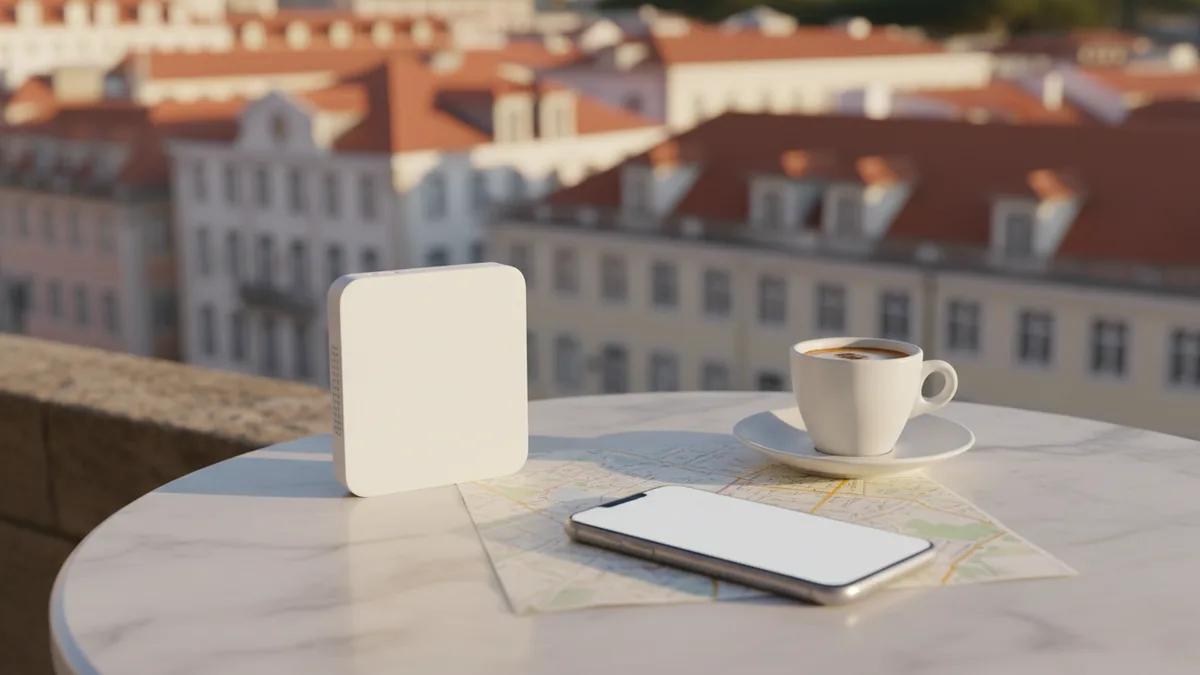
Here is the pocket WiFi vs eSIM answer for Portugal. If you are one person with a recent, unlocked phone, buy an eSIM. From three people up, or if you work from a laptop, or if you burn a lot of data, rent a pocket WiFi. A couple is a genuine coin-flip, and phone compatibility is the one thing that overrides all of it.
That is the whole answer. The rest is the evidence, because we sell both and can see which one people actually keep. The interesting part is not that eSIMs won: it is that they only won part of the market, and the part they did not win is the part with laptops and other people in it.
What eSIM genuinely does better
An eSIM is software. You buy it on your sofa, a QR code lands in your inbox, you scan it before you fly, and you land already connected. Nothing to collect at an airport counter. Nothing to charge overnight. Nothing to post back or drop off on the morning you are trying to make a flight. Your home SIM stays in the phone, so your bank's verification SMS still arrives.
For one traveller on a short trip, that is close to unbeatable. A Portugal eSIM starts at EUR 9, which is less than a taxi from the airport, and the setup is a thirty-second scan. If that describes your trip, stop reading and go buy one. We would rather you got the right product than the more expensive one.
This is also why the airport rental counter lost the casual tourist. That customer was never loyal to hardware. They wanted maps and WhatsApp to work, and eSIM does that with less friction. Nobody at a pocket WiFi company should pretend otherwise.
So why does anyone still rent a pocket WiFi?
Because "one traveller, one phone, light use" is a smaller slice of travel than the eSIM story assumes. Four things keep the rest of it on hardware.
1. An eSIM connects one device. A hotspot connects the group.
This is the structural difference that no software update fixes. An eSIM installs into a single phone, and the data belongs to that phone. To get anyone else online you tether, and tethering is where travel eSIMs get restrictive.
A rented hotspot inverts it. One device, one connection, everyone on it: phones, tablets, a laptop, the kids' console on a rainy afternoon. Nothing is installed on anyone's phone, which also means nothing to troubleshoot for the family member whose phone is locked to a carrier or eight years old.
An eSIM lives inside a single phone. To share it you have to tether, which drains that phone's battery and is throttled or blocked on most "unlimited" plans.
One rented pocket Wi-Fi shares a truly unlimited connection across the whole group - no phone battery burned, no tethering limits.
The cost shape follows. One eSIM is cheaper than one hotspot. Four eSIMs are not. We wrote the arithmetic out properly in how families save around half on travel internet.
2. Almost no laptop has its own SIM
The remote-work traveller is the segment that grew fastest, and it is the segment eSIM serves worst. The overwhelming majority of consumer laptops ship with no cellular modem at all: no SIM tray, no eSIM, nothing. Business lines like the ThinkPad X1 and the Surface Pro are the exception that proves it, and Apple has never shipped a Mac with a modem, though it is reportedly working on one. For everyone else, the only way to get a laptop online away from WiFi is to borrow a connection from something.
That something is either your phone or a dedicated router, and your phone is a bad router. It overheats, it drops the tether when the screen locks, and it burns the battery you need for the rest of the day. It is not a nicer version of a hotspot. It is a different category of device, and the difference shows up at hour three rather than minute one. The thermal detail is in why phones overheat when you hotspot.
3. "Unlimited" eSIM data is often not unlimited for sharing
Most unlimited travel eSIMs no longer police tethering directly. Airalo's fair-use policy says outright that there is no limit on tethering or the number of devices you connect; Holafly is the exception, capping hotspot sharing at up to 1 GB a day on its travel plans. What every unlimited plan does have is a daily full-speed allowance, and that is the number that decides your day: Airalo publishes 3 GB before it throttles you to 1 Mbps, Saily is reported around 5 GB. An hour of group video calling is about 1.35 GB, so a laptop plus a family plus one background cloud sync reaches the ceiling before lunch, and then everybody shares 1 Mbps.
Since we are naming other people's limits, here are ours. Our own Portugal eSIM is genuinely uncapped: no daily full-speed allowance, no separate tethering meter. It has a different catch, and it is a real one: carrier-level restrictions block tethering on some Apple devices, so if hotspotting from an iPhone is your plan, test it rather than assume it. Our sister brand eSIMpass sells an unlimited travel eSIM with a 4 GB per day full-speed allowance, which we spell out in the hidden truth about unlimited eSIMs.
None of this makes eSIMs dishonest. It makes them a phone product. Sharing was never what they were built for, and the full clause-by-clause version is in eSIM hotspot limits.
4. Most phones in the world still cannot take an eSIM
The industry talks about eSIM as if it were universal. In the phones people actually own it is not, yet. GSMA Intelligence put eSIM at roughly 5 percent of smartphone connections at the end of 2025, forecast to reach about 10 percent by the end of 2026. On device capability rather than usage, Counterpoint Research measured 23 percent of the installed base in 2024 and ABI Research 29 percent, leaving roughly three quarters of phones in active use without it. Flagships moved first. The billions of budget and mid-range handsets already in pockets did not, and people keep phones for years.
Then add carrier locking. A phone can support eSIM perfectly and still refuse a foreign profile because the carrier locked it, and a locked phone rejects a foreign SIM card for the same reason. That is not a rare edge case, especially on contract handsets from North America. Our guide to phones that still do not support eSIM in 2026 is one of the most-read things we publish, which tells you how many people hit this wall at the airport.
If one person in your group is on an incompatible or locked phone, the group-level answer stops being eSIM.
Should I get a pocket WiFi or an eSIM for Portugal?
| Your trip | Best option | Why |
|---|---|---|
| Solo, short city break, modern phone | eSIM | Cheapest, zero logistics, instant |
| Couple, light use | Either | Two eSIMs and one rental land within a few euros of each other at most durations, so pick on logistics |
| Family or group of three or more | Pocket WiFi | One connection, no per-person setup, and the cost stops multiplying |
| Remote work with a laptop | Pocket WiFi | Most laptops have no modem, and tethering caps bite hardest here |
| Heavy streaming or a long stay | Pocket WiFi | Truly unlimited, with no daily full-speed allowance to ration |
| Unlocked phone with no eSIM support | Data SIM card, or pocket WiFi | The eSIM profile simply will not install |
| Carrier-locked phone | Pocket WiFi | A locked phone rejects a foreign SIM card and a foreign eSIM alike |
| Road trip with several drivers | Pocket WiFi | One connection follows the car, not one person's phone |
The costs a comparison article usually leaves out
Every eSIM-vendor comparison of these two products makes the same argument, and it is a fair one: the rental price is not the rental cost. Deposits, outbound shipping, return postage, damage insurance, late fees and loss charges are real at plenty of rental companies, and they can double a cheap headline rate.
So here is our side of it in full, from our own terms, because this is the argument we would rather have than avoid.
| Cost item | Typical rental industry | Portugal Internet | Travel eSIM |
|---|---|---|---|
| Security deposit | Common, often held on a card | None | None |
| Delivery | Sometimes charged | Included | Not applicable |
| Return postage | Sometimes charged | Included, prepaid envelope, any CTT postbox | Not applicable |
| Damage insurance upsell | Common | Not sold | Not applicable |
| Late return | Charged, often steeply | EUR 5 per day, and we would rather you called us | Not applicable |
| Loss or theft of the device | Can be a large replacement charge | EUR 80 for the router | Nothing to lose |
| Data overage | Depends on the plan inside it | None, the data is uncapped | Throttled past the daily allowance |
The eSIM column is genuinely cleaner on four of those seven rows, and that matters. An eSIM cannot be left in a taxi, cannot be posted back late, and cannot be returned scratched. If those risks are what is putting you off a rental, they are legitimate, and for a solo traveller they usually settle the question on their own.
What the eSIM column cannot do is drop to zero when the day's data runs out, which is the trade you are actually making.
What this looks like in Portugal specifically
Our pocket WiFi, eSIM and data SIM all run on a native Portuguese network, so this is not a coverage debate. Signal is the same. What differs is shape, price and logistics.
The eSIM starts at EUR 9 for three days and arrives by email in minutes. The pocket WiFi rental starts at EUR 18 for three days, connects up to 10 devices on truly unlimited data, and we deliver it to your hotel, an airport terminal or a pickup point so you are not queuing at a counter. The data SIM card starts at EUR 15, for unlocked phones that cannot take an eSIM.
All three run on a local Portuguese subscription rather than a roaming multi-country profile, which is a real difference from the "works in 100+ countries" rental hotspots and worth understanding before you book either: we pulled it apart in what is actually inside a rental pocket WiFi.
Pocket WiFi remains the bigger seller for us and the eSIM is the faster-growing one, which tracks trip shape more than technology preference: longer stays mean more devices, more laptop hours and more people sharing. Short city breaks skew heavily to eSIM, exactly as the theory predicts. The product-by-product breakdown lives on our eSIM vs pocket WiFi vs SIM card page.
Can you use a pocket WiFi and an eSIM together?
Frequent remote workers often do, and it is a sensible setup rather than a redundant one. The eSIM keeps your phone independently connected, so navigation and calls survive a flat hotspot battery or the twenty minutes it spends charging in your bag. The hotspot carries the laptop, the tablet and anyone travelling with you, without touching your phone's battery on a day full of calls.
Which is the framing worth keeping: these are not competitors fighting over the same job. They are answers to different questions that happen to sound alike.
Land in Lisbon or Porto with your hotspot already waiting
We deliver an unlimited pocket Wi-Fi to your hotel or airport terminal. No setup - turn it on and connect up to 10 devices.
Frequently asked questions
Is pocket WiFi still worth it in 2026, or should I just get an eSIM?
It depends entirely on how many devices you need online. For one traveller with a modern unlocked phone and light usage, an eSIM is cheaper and simpler and you should buy one. From three people up, for laptop work, or for heavy data use, a pocket WiFi is still the better product because it shares one truly unlimited connection across up to 10 devices without touching anyone's phone. A couple is a genuine coin-flip.
Is a pocket WiFi cheaper than buying several eSIMs?
From three people up, yes. One eSIM is cheaper than one hotspot, and for a couple the two land within a few euros of each other depending on trip length, so price should not decide it. Past that the eSIM cost multiplies per person while the hotspot cost does not: a family of four buying four separate plans pays substantially more than one rental that covers every phone, the tablet and the laptop at once.
Can I use a pocket WiFi and an eSIM at the same time?
Yes, and frequent travellers often do. The eSIM keeps your phone independently connected for calls and navigation if the hotspot battery dies or is charging in your bag, while the hotspot carries the laptop, the tablet and anyone travelling with you. Both run on the same Portuguese network, so the combination is about resilience and battery life rather than coverage.
What should I choose if my phone does not support eSIM?
If the phone is unlocked, either a physical data SIM card or a pocket WiFi will work. If the phone is carrier-locked, only the pocket WiFi will help, because a locked phone rejects a foreign SIM card just as it rejects a foreign eSIM profile. A hotspot does not care what any phone supports, because it creates its own WiFi network.
Does an eSIM work for a family or a group?
Only by buying one per person, or by tethering, and most travel eSIMs restrict tethering. That is the structural limit: an eSIM profile lives inside a single phone and the data belongs to that phone. A pocket WiFi inverts it, putting one connection on the outside of every device so nothing has to be installed on anyone's phone.