
What Is a MiFi? Portable WiFi Hotspots Explained
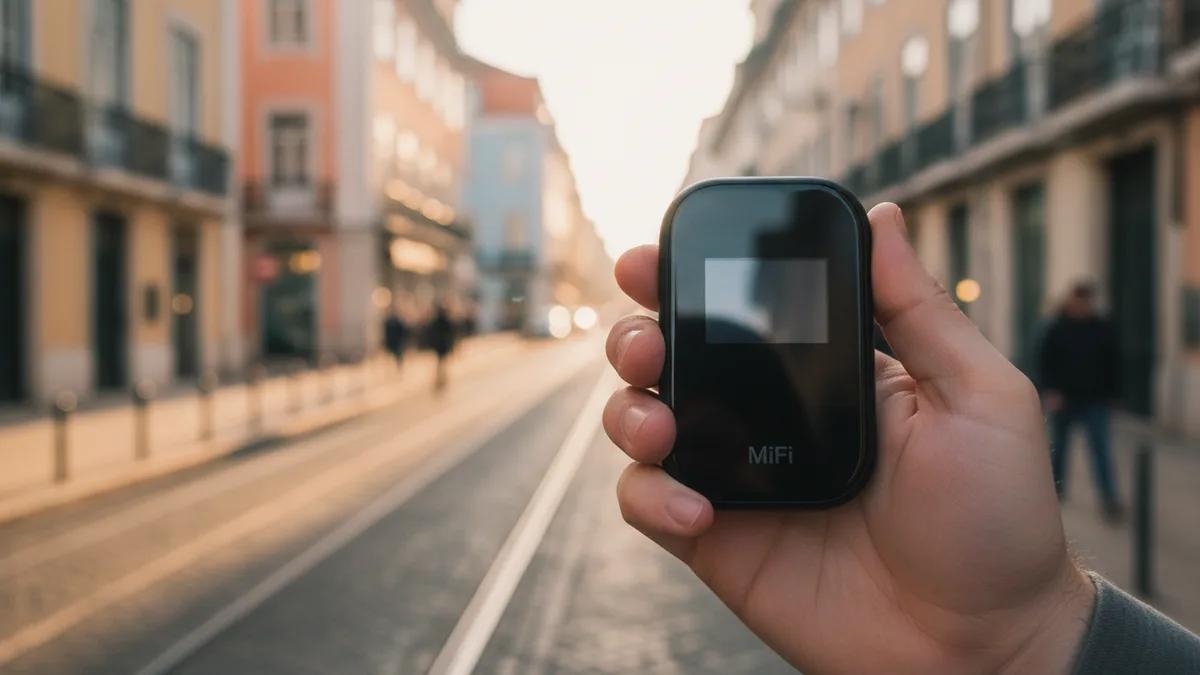
A MiFi is a pocket-sized battery-powered router that takes a mobile data connection and turns it into a private WiFi network for your devices. Pocket WiFi, portable WiFi hotspot, mobile router and travel router are all names for the same thing. MiFi started as a brand name, and is still a registered trademark held by Inseego in the United States and Hutchison 3G in the UK, but it became the everyday word for the whole category, like Hoover or Biro.
The naming confusion is worth clearing up first, because it is why this device is harder to shop for than it should be. Search for a MiFi and you will find portable routers. Search for pocket WiFi and you will find rentals. Search for a mobile hotspot and you will find your phone's tethering settings. Same idea, four vocabularies, and they rarely link to each other.
How does a MiFi work?
Physically it is smaller than a phone and thicker, often with a small screen showing signal and battery. Inside there are three parts that matter.
A cellular modem connects to 4G or 5G towers, exactly like the one in your phone, except this is the only radio job the device has to do. A SIM, physical or embedded, holds the subscription that authorises the connection. A WiFi radio broadcasts a small private network, typically for up to 10 or 15 devices depending on the model. A battery runs all three for a working day.
You switch it on, connect your laptop and phone to its network name with a password, and everything on it shares one mobile data connection. Nothing is installed on any device. Nothing changes on any phone. That is the entire product.
What is a portable WiFi hotspot?
The same device, under the name most people search for. "Portable WiFi hotspot" and "mobile hotspot" are used two ways, and the ambiguity is the source of most confusion.
A dedicated hotspot is the hardware described above: a MiFi, a pocket WiFi, a standalone router with its own battery and its own subscription. A phone hotspot is the tethering feature in your phone's settings, which turns the phone itself into a temporary router using the phone's own data plan. Both create a WiFi network your laptop can join. Only one of them is built to do it for eight hours.
MiFi vs tethering vs eSIM: what is different?
These three overlap, and the differences only show up under load.
| MiFi / pocket WiFi | Phone tethering | Travel eSIM | |
|---|---|---|---|
| Devices served | Up to 10 or 15 | A handful, in practice | 1 (the phone) |
| Setup on each device | Join a WiFi network | Join a WiFi network | Install a profile per phone |
| Battery impact | Its own battery | Drains your phone hard | Normal phone use |
| Heat and throttling | Built for continuous load | Phone gets hot and slows | Not applicable |
| Sharing limits | None on a proper rental | Set by the plan behind it | Commonly capped or blocked |
| Works with old or locked phones | Yes, any WiFi device | Depends on the phone | No |
| Cost for one person | Highest | Included, but metered | Lowest |
Tethering is not a separate technology from a MiFi so much as a worse implementation of it: a phone doing a router's job with a router's radio requirements and none of a router's thermal design. The plan behind the tether is usually the real constraint, since most travel eSIMs cap tethered data at a few hundred megabytes a day.
An eSIM is not a device at all. It is a way of storing the subscription, and many modern MiFi units store theirs the same way. The two are not opposites.
What should I look for in a MiFi?
- Battery life under real load, not the headline figure. Six to ten hours of actual use with several devices connected is a realistic good result. Anything advertising far more is usually measured with one idle device attached.
- How many devices it supports, and whether the number is a hard limit or a performance cliff. Ten is plenty for a family. Fifteen matters for a small team.
- Which network it uses, and as what. A local domestic subscription gets domestic treatment. A roaming or cloud SIM profile may be deprioritised on congested cells and capped below the local 5G ceiling, which we unpack in what is inside a rental hotspot.
- Whether the data is genuinely uncapped. A device is only as unlimited as the plan inside it. Check for daily full-speed allowances and fair-use throttling, not just the word unlimited.
- Charging standard. USB-C means one cable for everything. Micro-USB in 2026 means a second cable in your bag.
- Whether it can charge while sharing. Some cheap units get unpleasantly hot doing both. If it cannot, a power bank in your daypack is the difference between a full day out and a dead device by 4pm.
Should I buy or rent a MiFi?
The honest failure mode of buying is not the money. It is landing at 11pm with a device you cannot use, because every SIM counter in the airport is closed.
You can buy an unlocked MiFi outright, with basic 4G units selling for double-digit euros and current 5G models running into the hundreds, then feed it a local prepaid SIM in each country you visit. Buying makes sense if you are abroad often, if you can be bothered to buy and register a local SIM on arrival, and if you will use it enough to amortise the hardware. In many countries a tourist SIM means a shop visit with your passport, which is fine once and tedious annually.
Renting makes sense for a single trip, or several trips a year, especially where registration rules make prepaid SIMs a chore. You skip the hardware cost, you skip the shop, and the device arrives configured on a local network with support attached. If it fails, replacing it is somebody else's problem.
Is a MiFi still worth it in 2026?
For one person on a phone, no. Buy an eSIM: cheaper, lighter, nothing to return. We say that as the company renting the alternative.
For groups, for laptops and for mixed-compatibility phones, the device kept its job, and pocket WiFi vs eSIM works through exactly where the line falls.
Renting a MiFi in Portugal
Our pocket WiFi rental is the device described above: a portable 4G and 5G router on a native Portuguese network, truly unlimited data with no fair-use throttle, up to 10 devices at once, from EUR 18 for three days.
Because the awkward part of a rental is logistics rather than technology, we deliver it to your hotel, to an airport terminal, or to a pickup point anywhere in Portugal, and you send it back at the end. No counter queue on arrival, no shop visit, no local registration paperwork. If a physical SIM suits you better, the data SIM card uses the same network, and the side-by-side comparison covers all three options in one place.
Land in Lisbon or Porto with your hotspot already waiting
We deliver an unlimited pocket Wi-Fi to your hotel or airport terminal. No setup - turn it on and connect up to 10 devices.
Frequently asked questions
What is a MiFi?
A MiFi is a small battery-powered router that receives a 4G or 5G mobile data signal and rebroadcasts it as a private WiFi network for your own devices. Pocket WiFi, portable WiFi hotspot, mobile router and travel router all describe the same device. MiFi began as a brand name, and is still a registered trademark, but became the everyday word for the whole category.
What is the difference between a MiFi and a mobile hotspot?
None, when people mean a dedicated device: MiFi, pocket WiFi and portable hotspot are the same thing. The term mobile hotspot is also used for the tethering feature built into a phone, which does a similar job with worse results because the phone runs two radios at once, overheats, drains its battery and is often limited by the data plan behind it.
Is a MiFi better than tethering from my phone?
For anything sustained, yes. A MiFi has a dedicated modem, better antenna placement than a phone packed with other components, and a battery whose only job is the connection. Tethering makes your phone run its cellular and WiFi radios simultaneously, which causes heat, throttling and heavy battery drain, and most travel data plans cap or block tethered traffic.
Should I buy a MiFi or rent one?
Buy one if you travel abroad frequently and do not mind buying and registering a local prepaid SIM in each country. Basic 4G units sell for double-digit euros and current 5G models run into the hundreds. Rent one for a single trip or a few trips a year, where you avoid the hardware cost, arrive with the device already configured on a local network, and have support if it fails.
Is a MiFi still worth it in 2026?
For one person with a modern phone, no: buy a travel eSIM instead, it is cheaper and there is nothing to return. For groups, for laptop work and for mixed groups where somebody's phone is old or carrier-locked, a MiFi is still the better answer, because it shares one connection across every device without anything being installed on anyone's phone.