
Do Pocket WiFi Devices Use eSIM? What Is Inside One
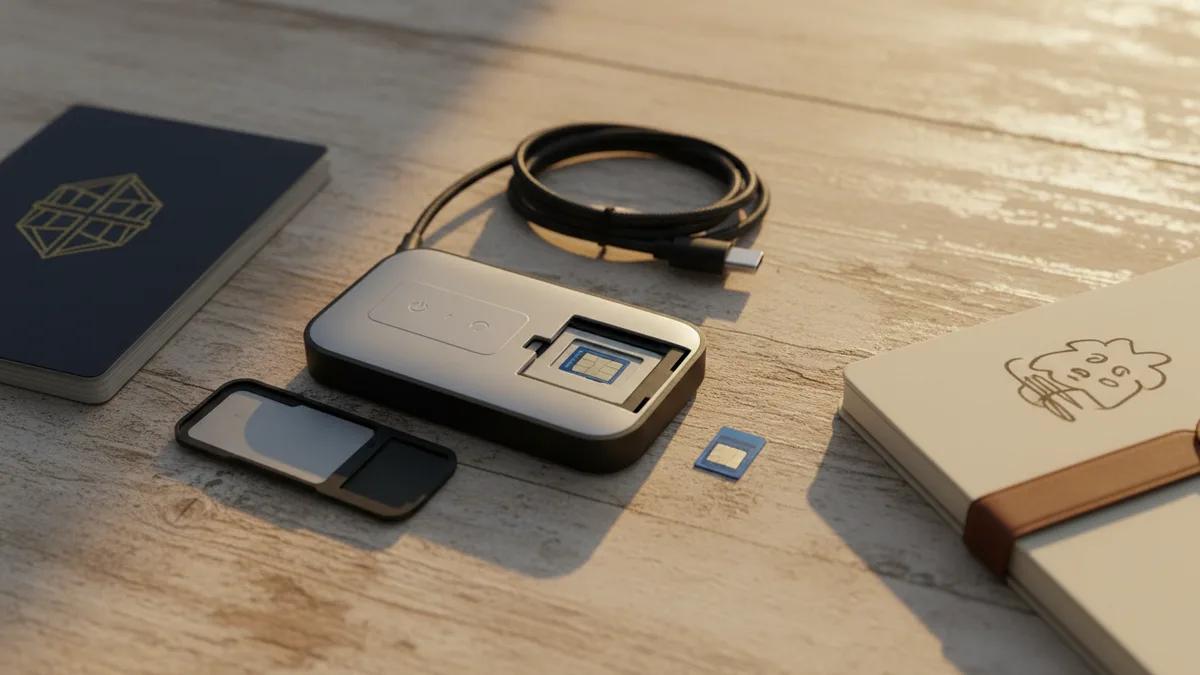
Yes, plenty of them do. Modern pocket WiFi devices increasingly run on an embedded SIM rather than a plastic card, and some use multi-carrier cloud SIM profiles that choose a network when you land. Which design your rental uses is the difference between a hotspot that works in the arrivals hall and one that does not.
People find this surprising because the popular framing sets eSIM against pocket WiFi, as if one replaced the other. The technology never split that way. eSIM is a way of storing a mobile subscription. A pocket WiFi is a box that shares one. Increasingly, the box stores its subscription exactly the way your phone does.
How does a rental hotspot get online?
Three designs, and the differences are invisible in the marketing and very visible in use.
| Physical SIM, local network | Embedded SIM (eSIM / eUICC) | Cloud SIM, multi-carrier | |
|---|---|---|---|
| Where the subscription lives | A real SIM card in a slot | A chip soldered to the board | Assigned on arrival by a platform |
| Who picks the network | The rental company, before you get it | The rental company, remotely | The platform, when you switch on |
| You are treated as | A domestic customer | Depends on the profile loaded | Almost always a roaming guest |
| Speed ceiling | The local network's own | The local network's own | Whatever the roaming deal allows, 5G sometimes excluded |
| Time to first byte on arrival | Under a minute | Under a minute | Longer, the profile has to be negotiated |
| Crosses borders | No, tied to one country | Only if reprovisioned | Yes, that is the point |
| Typically used for | Country-specific rentals | Newer rental fleets | "Works in 100+ countries" rentals |
Physical SIMs are still common in country-specific rentals, and embedded SIMs are quietly replacing them: same local subscription, no tray to dislodge, and the company can reprovision it remotely. The chip is a eUICC, the same standard family as the eSIM in your phone, though rental fleets are typically managed under the machine-to-machine profile specification rather than the consumer one your phone uses, which is why you never see a QR code.
Cloud SIM is the genuinely different animal, because the network is chosen for you after you land. Most "works in 100+ countries" rental hotspots are built on a small number of platforms, uCloudlink being the best known, and the same technology sits behind consumer brands like Solis and the no-SIM travel routers sold on marketplaces.
Does a pocket WiFi need a SIM card, and does it work without a signal?
Yes to the first, and this is the most common misconception worth clearing up: a pocket WiFi always needs a mobile subscription, whether that lives on a plastic card, a soldered chip or a cloud profile. It is not an independent internet source.
Which leads to the honest limits:
- It does not create or boost signal. A hotspot is a client of the mobile network exactly like your phone. Where your phone has one bar, so does the hotspot. A better antenna and a dedicated modem help at the margins, and that is all.
- No cellular signal means no connection. Deep in the Azores interior or on a remote Madeira levada, a hotspot is as offline as everything else. Download offline maps.
- It does not work on a plane, and on a cruise ship it works only in port and near the coast, where it can still reach a land network. Mid-ocean there is nothing to attach to, and ship WiFi is satellite, which a hotspot cannot use.
- 5G is where the local network offers it, which in Portugal means the cities, most towns and the main motorways, with 4G everywhere else including Madeira and the Azores.
What does that change for you?
You will never notice any of this while the connection is fast. Here is what it explains on the day it is not.
A domestic subscription is treated as a home customer; a roaming cloud profile is a guest, and guests can be deprioritised on congested cells. In a packed arrivals hall or a festival crowd, that is the whole experience. Roaming agreements can also cap throughput or exclude 5G even where the local network offers it, and multi-country units take longer to settle on arrival because the profile has to be negotiated before anything works. If you have ever switched on a global rental hotspot at an airport and watched it think for several minutes, that is the handshake.
Support is the quiet one. With a local operator you are on one network with one set of towers, and a support conversation is about coverage. With a cloud platform, a failure could be the local partner, the profile or the platform, which is three support conversations instead of one.
Neither approach is dishonest. A traveller crossing five countries in three weeks genuinely benefits from a cloud SIM unit. A traveller spending three weeks in one country almost always does better on that country's own network.
Which design do we use?
Ours is the country-specific one. Our pocket WiFi rental carries a subscription on a native Portuguese network, the same towers locals use, rather than a roaming multi-country profile. That is the deliberate trade: the device will not follow you to Spain, and in exchange you are a domestic customer in Portugal for the whole trip, with truly unlimited data and no roaming asterisk.
It is the same reasoning behind our Portugal eSIM and our data SIM card. One country, done properly, on local infrastructure. If your itinerary is genuinely multi-country, a global cloud SIM rental or a regional eSIM is a better fit than we are. And if you are one person on a modern phone for a week, none of this matters much: buy the eSIM, it is cheaper and there is nothing to return.
Can you put your own eSIM into a pocket WiFi?
Sometimes, and it is a legitimate route if you already own hardware. Consumer travel routers do exist with eSIM support, and some let you install a QR-code profile the same way a phone does. Buying a data-only eSIM and loading it into a router you own gives you a shared connection without renting anything, which is a good setup for people who travel constantly.
Three cautions before you go that way. Most travel eSIM plans are written for phones, and some providers' terms restrict installing a profile in a router, so check before you pay. Router installation is fiddlier than a phone: some models want you to scan the QR through a web admin panel, and a failed install can burn the profile, which is usually single-use. And the plan's fair use and tethering clauses still apply, except that now every device on the router counts as tethered traffic, which is exactly the trap described in eSIM hotspot limits.
For a one-off trip, the arithmetic rarely favours buying hardware. For a nomad abroad half the year, it often does.
Is a pocket WiFi the same as an eSIM?
No, but not for the reason most people assume. The same technology can be inside both. The real question is who the subscription belongs to and how many devices it serves.
An eSIM plan puts one profile in one phone, and sharing it is an exception the provider limits. A rental hotspot puts a profile, often the same kind of profile, in a device whose entire purpose is sharing. That is why both keep selling. The decision guide is pocket WiFi vs eSIM, and if the terminology is what is tripping you up, start with what MiFi actually means.
Land in Lisbon or Porto with your hotspot already waiting
We deliver an unlimited pocket Wi-Fi to your hotel or airport terminal. No setup - turn it on and connect up to 10 devices.
Frequently asked questions
Do pocket WiFi devices use eSIM?
Many do. Rental hotspots come in three broad designs: a physical SIM card from a local operator, an embedded SIM chip provisioned remotely by the rental company, or a multi-carrier cloud SIM that is assigned a profile for wherever you land. Physical SIMs remain common in country-specific rentals, while embedded and cloud designs dominate the multi-country ones. The technology is the same family your phone uses.
What is a cloud SIM pocket WiFi?
A cloud SIM hotspot holds no fixed home network. When you switch it on it contacts a management platform, receives a profile for your current country and attaches to a partner network there. That is how one device can work in 100 or more countries. The trade-off is that you are usually a roaming guest on that network, which can mean lower priority on busy cells, possible speed caps and a slower first connection on arrival.
Is a local SIM pocket WiFi better than a cloud SIM one?
For a single-country trip, usually yes. A device on a local operator's subscription is treated as a domestic customer with no roaming restrictions, while a cloud SIM device is a guest on the network it selects. For a multi-country itinerary the cloud SIM device wins on convenience, because it follows you across borders without a swap.
Can I put my own eSIM into a portable WiFi router?
On some consumer travel routers, yes. Models with eSIM support let you install a QR-code profile through a web admin panel. Check first that your eSIM provider permits installation in a router rather than a phone, be careful during setup because a failed install can consume a single-use profile, and remember that the plan's fair use and tethering limits still apply to every device connected to the router.
Does a pocket WiFi need a SIM card, and does it work without a signal?
Yes, a pocket WiFi always needs a mobile subscription, whether it lives on a plastic SIM card, a soldered eUICC chip or a cloud profile assigned on arrival. It is not an independent internet source. It also does not create or boost signal: it is a client of the mobile network exactly like your phone, so where your phone has no coverage neither does the hotspot. It will not work on a plane, and on a cruise ship only in port or near the coast.
Which network does a Portugal Internet pocket WiFi use?
A native Portuguese network, the same towers local subscribers use, rather than a roaming multi-country cloud profile. That means you are a domestic customer rather than a roaming guest, with no roaming speed caps, 4G across all of Portugal including Madeira and the Azores, 5G where the network offers it, and truly unlimited data. The trade-off is that the device is intended for Portugal rather than for crossing borders.