
Power Plugs & Adapters in Portugal: What You Need
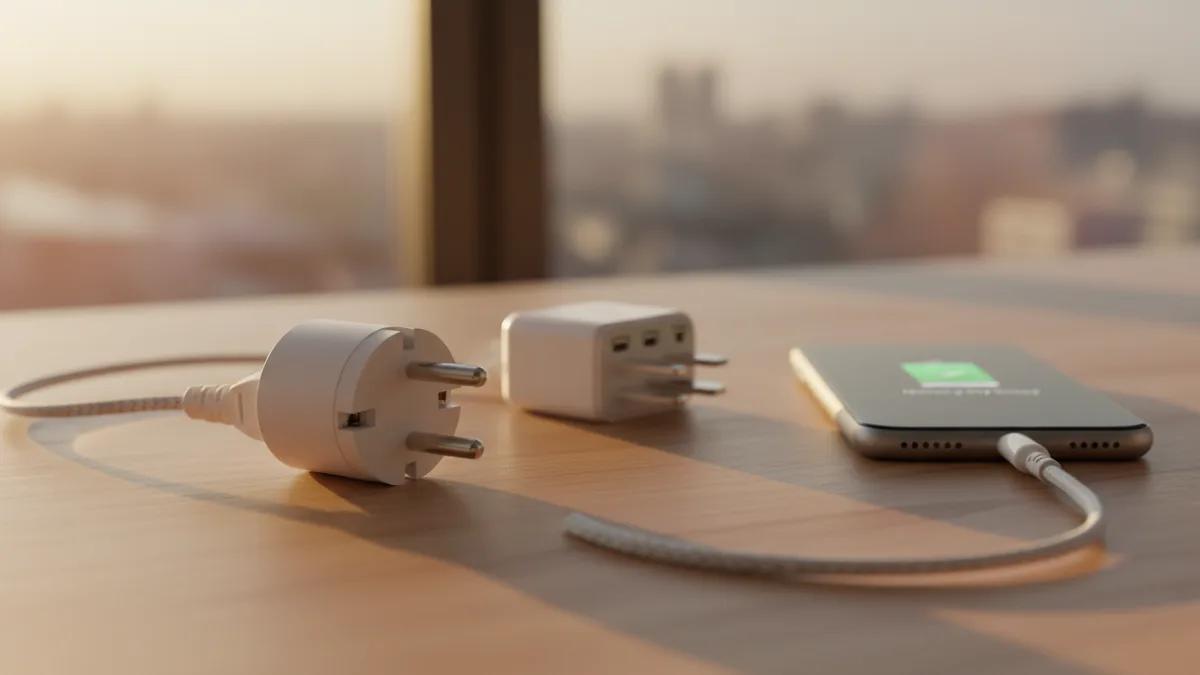
Sorting out plugs and adapters is one of those small trip details that is easy to forget and annoying to fix once you land. The good news: Portugal uses the same standard European setup as Spain, France and Germany, so once you know the basics you are covered for the whole country, from a Lisbon apartment to a farmhouse in the Douro.
Here is exactly what fits, what you need to pack based on where you are coming from, and how to keep a growing pile of devices charged while you travel.
What outlets Portugal uses
Portugal uses Type F outlets, which also accept Type C plugs. These are the familiar round two-pin European plugs: Type C is the slim ungrounded "Europlug", and Type F is the grounded "Schuko" plug with two earth clips on the sides. A Type C plug fits happily into a Type F socket, so in practice one European-style adapter handles everything you will meet in Portugal.
The electricity supply runs at 230 volts and 50 hertz. That is the standard across continental Europe and it matters most for travelers coming from countries that run on lower voltage, which we cover below.
You will find these outlets everywhere: hotels, apartments, cafes, trains and airports. There is nothing regional or unusual to worry about within Portugal itself, including the Azores and Madeira.
What you need, by where you are from
United States and Canada
You need two things to think about. First, a plug adapter: US and Canadian plugs (the flat-pin Type A and B) do not fit Portuguese outlets, so you need a Type C or Type F adapter. Second, voltage: North America runs on about 120V while Portugal runs on 230V.
The reassuring part is that most modern electronics are dual-voltage. Look at the charging brick or the label on your device and find the input rating. If it reads "INPUT: 100-240V, 50/60Hz", it is dual-voltage and safe to use in Portugal with only a plug adapter. Phones, tablets, laptops and camera chargers almost always pass this test.
The exception is single-voltage gear, typically heat appliances like some US hair dryers, curling irons, straighteners and older electric shavers rated for 120V only. Plug one of those straight into a Portuguese socket and it can burn out or worse. For those you need a proper voltage converter, or better still, buy a cheap dual-voltage travel version or just use what the hotel provides.
United Kingdom and Ireland
You need a Type G to Type F adapter. British and Irish plugs are the chunky three-rectangular-pin design and will not fit Portuguese sockets. The good news on voltage: the UK and Ireland already run at 230V, the same as Portugal, so no converter is needed. Any device that works at home works here with just the adapter.
Australia and New Zealand
You need a Type I to Type F adapter for the angled-pin Australian and Kiwi plugs. Voltage is essentially the same (around 230V at 50Hz), so again, no converter is required, just the adapter.
Rest of Europe
If you are coming from Spain, France, Germany, the Netherlands, Italy or most of mainland Europe, you are already plug-compatible and running the same 230V. You can plug straight in with nothing extra. Travelers from a few countries with different plug styles may still want a small adapter, but the vast majority need nothing at all.
Buying and packing adapters
A universal travel adapter is the simplest choice if you travel to different regions, since one unit covers Portugal and beyond and usually includes built-in USB ports. If you only ever visit Europe, a couple of cheap single-purpose Type C or F adapters are lighter and cost very little.
Pack them in your carry-on so you can charge during layovers. If you forget, you can buy adapters at Lisbon and Porto airports and in electronics shops, supermarkets and larger pharmacies once you arrive, though airport prices are the least kind. For more general prep, our Portugal travel tips guide rounds up the practical bits worth sorting before you fly.
Charging a bag full of devices
Modern travelers carry more that needs charging than ever: a phone, maybe a second phone, a pocket WiFi hotspot, a power bank, earbuds, a camera, a tablet. A single wall socket does not go far.
A few habits keep everything topped up:
- Bring one good multi-port charging brick. A single dual-voltage USB-A and USB-C brick with three or four ports lets you charge several devices from one adapter overnight, which matters when a room has only one or two free outlets.
- Know your cables. Newer phones and laptops use USB-C, while plenty of accessories still use USB-A, so carry both cable types. USB-C also charges faster for phones and tablets that support it.
- Carry a power bank for long days. Outlets are scarce when you are out on a walking tour, a coastal day trip or a train across the country. A power bank keeps your phone and your pocket WiFi alive so maps, tickets and translation apps do not die mid-afternoon. On a self-drive holiday, a car USB charger is worth having too; see our Portugal road trip internet guide for staying connected between towns.
- Mind the airline rule for power banks. Lithium power banks must travel in your carry-on bag, never in checked luggage. Most airlines allow them up to 100Wh (roughly 27,000mAh) without special approval. Keep them in the cabin and you will not have any trouble at security.
If staying online is a priority, deciding how you connect is worth a moment too. A rented pocket WiFi shares a signal across all your devices from one charged unit, while an eSIM for Portugal or a local data SIM card keeps a single phone connected. Whichever you choose, it is one more thing on the charging pile, which is exactly why a spare brick and a power bank earn their place.
Quick pre-trip checklist
- Confirm your plug type at home and pack the right Type C or F adapter (or a universal one).
- Check every charger label for "INPUT: 100-240V". Dual-voltage means adapter only.
- Flag any single-voltage heat appliances and leave them home or plan for a converter.
- Pack a multi-port USB brick and both USB-A and USB-C cables.
- Bring a power bank in your carry-on for long days out.
- Keep adapters and chargers in your hand luggage, not the hold.
Get these six things right and power is a non-issue for your whole trip. For more on trains, driving and moving around once you land, our getting around Portugal guide picks up where this one leaves off.
Frequently asked questions
What kind of power plug does Portugal use? Portugal uses Type F outlets, which also accept Type C plugs. These are the standard round two-pin European plugs (the Europlug and Schuko designs). The supply is 230 volts at 50 hertz, the same as the rest of continental Europe.
Do I need a plug adapter for Portugal? If you are coming from the US, Canada, the UK, Ireland, Australia or New Zealand, yes. Your home plugs will not fit a Portuguese outlet, so you need a simple Type C or Type F plug adapter. Travelers from most of mainland Europe can plug straight in.
Will my US charger work in Portugal without a voltage converter? Most phone, tablet, laptop and camera chargers are dual-voltage. Check the small print on the brick for "INPUT: 100-240V". If you see that, you only need a plug adapter. Single-voltage items like some US hair dryers are 120V only and will be damaged without a voltage converter.
Do Portuguese hotels have USB ports? Many newer and mid-range hotels now include USB-A or USB-C ports built into bedside lamps or wall plates, but you cannot count on it everywhere. Bring your own charging brick and adapter so you are never stuck, especially in older guesthouses.
Can I bring a power bank to Portugal on the plane? Yes, but power banks must go in your carry-on bag, never in checked luggage, because they contain lithium batteries. Most airlines allow power banks up to 100Wh (about 27,000mAh) without special approval. Keep them in your cabin bag and do not pack them in the hold.
Stay connected across Portugal
Rent a pocket WiFi hotspot and keep every device online from one charged unit, wherever your trip takes you.