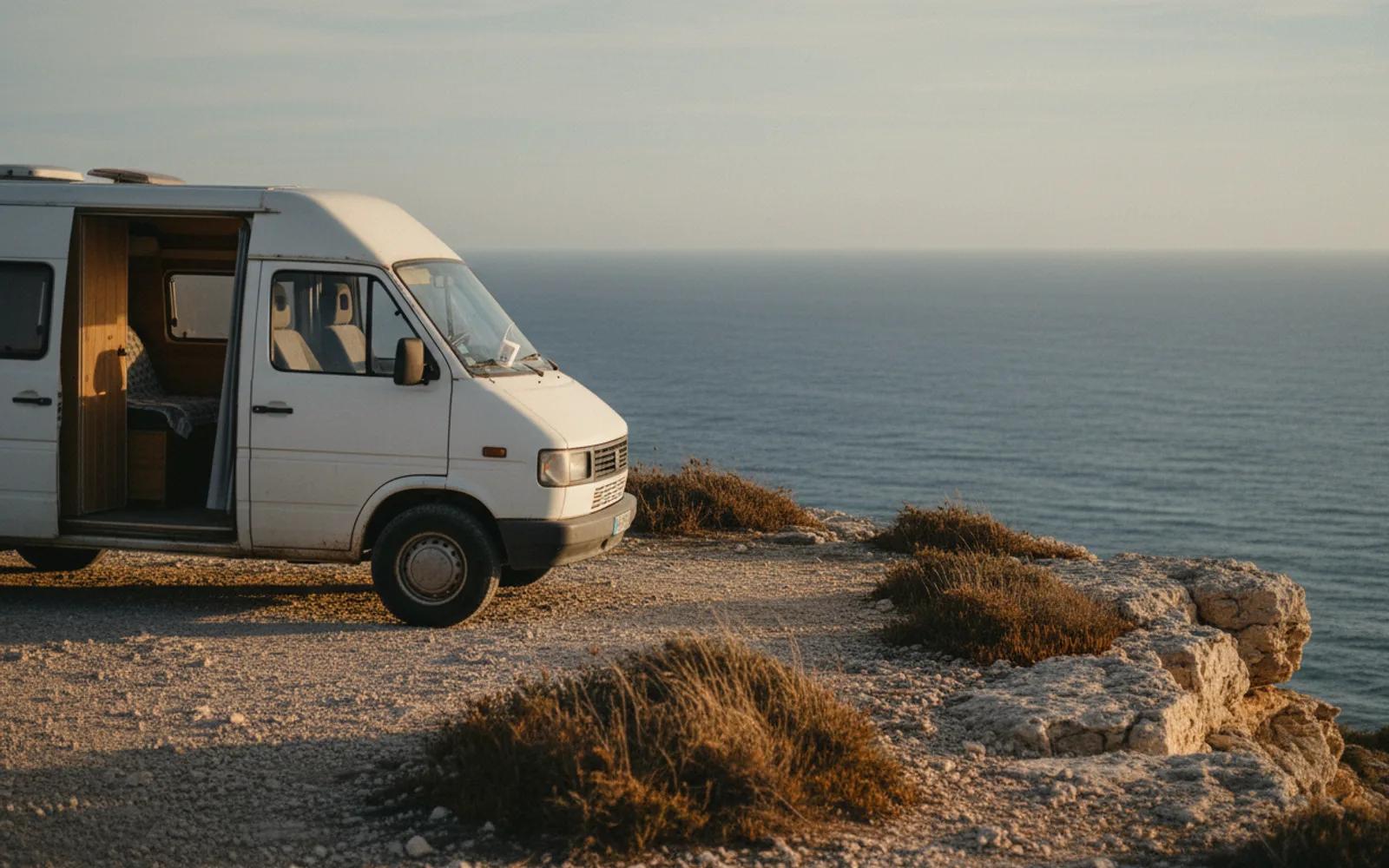
Why tethering fails first in a van
On a road trip the phone is already doing the two hardest jobs: live navigation on screen, and photographs. Turning it into the hotspot for a second phone and a laptop is what finally kills it, and a hot phone in a windscreen mount on an Algarve afternoon throttles itself before the battery even runs down. A separate hotspot moves that load off the device you actually need working. It sits on the dashboard, draws its power from the van, and leaves the phone free to be a phone.
Power: 12V, USB and the honest numbers
The hotspot runs 6 to 8 hours of continuous use on its own battery, and it charges while you use it. That is the number that decides your setup. For a day at the beach it is simply enough. For a working day, or a van where the connection stays up from breakfast to bed, plug it in and treat it as always-on: it charges over USB, so the 12V socket, a USB port, a power bank or a solar controller all work with no adapter hunting. We rent a car charger, a power bank and a spare battery at 5 EUR each precisely because van customers kept asking, and the car charger is the one to take - it means the hotspot tops up on every drive between spots without touching the leisure battery.
What actually arrives, and what it does
The box holds the hotspot ready to use, a mains charger with Portuguese plugs, the WiFi password, and a pre-addressed return envelope - so the return is already solved on the day it arrives, which matters more than usual when you have no fixed address. On speed, the honest figure is up to 150 Mbps download on 4G LTE and 5G, with real-world rates depending on where you have parked. That is comfortably beyond what a van full of streaming, video calls and navigation needs; the variable in a van is never bandwidth, it is signal and power.
Where the coverage really is, and where it is not
Portugal Internet runs on NOS and Vodafone, two of the country's leading networks, and along the routes vans actually drive - the N125, the coastal Algarve, the Silver Coast, the N2, the Douro valley - coverage is good to excellent. Be realistic about the exceptions: deep rural Alentejo, the Peneda-Geres mountains, some Costa Vicentina cliff parking and the interior valleys genuinely drop signal. The honest setup is unlimited data so you never ration it, plus offline maps downloaded before the day starts.
Placement beats hardware
The single biggest improvement most vans can make costs nothing: move the hotspot. A device on the dashboard, a window shelf or hung near the skylight routinely holds a usable signal where the same device in a drawer under a metal-skinned bed does not. A van is a small metal box, and that matters more than people expect. Try the window before concluding there is no coverage in the car park.
Wintering in the Algarve: the number that decides it
The Algarve fills with Northern European motorhomes from October onward, and those are not two-week trips, they are three-month stays. Here is the pricing that matters for them, stated plainly because almost nobody in this market states it: after day 30, every additional day costs 1 EUR. Not a lower tier, not a discount code. One euro. A 30-day rental is 83 EUR; 90 days is 143 EUR, which is 1.59 EUR a day; a full 180 days is 233 EUR, or 1.29 a day. Competitors advertising 3.30 or 3.95 EUR a day would charge roughly 297 and 356 EUR for that same 90-day winter. We are not the cheapest headline in this market and we do not pretend to be - we are the cheapest by a wide margin the moment a stay runs past about three weeks, which is exactly the shape of vanlife. Roughly 1 in 6 of our rentals already runs past a month, and an active rental can be extended online without returning anything.
A word on overnight parking
Rules on overnighting outside designated areas in Portugal tightened in recent years and are enforced locally, with the coastal Algarve and the southwest natural park among the stricter places. We are not the authority on this and the details change, so check current rules and use official aires, ASAs and campsites where they apply. The connectivity consequence is real though: the legal spots are often the rural ones, which is exactly where a strong shared connection stops being a convenience.
Collecting and returning it without a fixed address
The obvious problem with renting anything when you live in a vehicle is where it gets delivered. Devices ship anywhere in mainland Portugal, Madeira and the Azores: to a campsite reception, a hotel you are stopping at, an airport pickup on the day you land at Lisbon, Porto or Faro, or any of more than 6,000 CTT and Chronopost pickup points, which is usually the easiest answer on a moving route. Returns run the same way in reverse, from wherever the trip ends rather than where it started. We have run this network from Maia, outside Porto, since 2015, across more than 27,000 travellers - a van with no address is a normal booking here, not a special case.